The dishes look clean when you open the dishwasher — but they're sitting in a puddle, glasses have water pooled inside them, and plastic containers are dripping wet no matter how long the cycle ran. You run an extra dry cycle and it barely helps.
This is one of the more confusing dishwasher complaints we hear from homeowners across Elmwood Park, Chicago, and the surrounding suburbs — confusing because the dishwasher is clearly running a full cycle, the dishes are clean, and yet drying never quite happens.
Why are my dishes still so wet after the dishwasher finishes?
Drying is a separate function from washing, and several different things have to work correctly for it to happen. When dishes come out wet, the cause is almost always one of four things — and the pattern of where the water sits often tells you which one it is.
1. The heating element has failed or weakened
Most dishwashers use a heating element to raise the air temperature inside the tub during the dry cycle, which speeds up evaporation. If the element has failed completely, dishes come out exactly as wet as they went in. If it's only partially failed, drying is noticeably slower and less complete than it used to be, especially on plastic items that don't hold heat well.
Signs: Dishes feel cold or room-temperature at the end of the cycle rather than warm, drying has gradually gotten worse over weeks or months, or the dishwasher used to dry dishes well and now doesn't at all.
What to try: Open the dishwasher right when the cycle ends and feel the inside of the tub and the dishes. If everything feels cool rather than warm, the heating element is the likely cause and needs to be tested.
2. The rinse aid dispenser is empty or not dispensing
Rinse aid changes the surface tension of water so it sheets off dishes and glassware instead of forming droplets. Without it, water collects in beads and pools — especially inside glasses, on plastic, and on the upper rack — even when the heating element is working perfectly.
Signs: Water spots or streaks on glassware, droplets pooling specifically inside cups and glasses, plastic items noticeably wetter than ceramic or glass dishes in the same load.
What to try: Check the rinse aid dispenser, usually located next to the detergent compartment, and refill it if empty. Run one full cycle after refilling — it sometimes takes a cycle or two for the dispenser to begin releasing it consistently again. If the dispenser is full but dishes are still beading water, the dispenser cap or release mechanism may be stuck.
3. The vent fan or vent flap isn't venting moisture properly
Many dishwashers use a small vent that opens during the dry cycle to let humid air escape from the tub, sometimes paired with a fan that actively pulls air through. If the vent is stuck closed, or the fan motor has failed, moisture has nowhere to go and condenses right back onto the dishes instead of escaping.
Signs: A burst of steam or strong humid smell when you open the door right after the cycle ends, dishes wet all over rather than just where water naturally pools, or a faint clicking or whirring sound from the vent area during the dry portion of the cycle that has stopped happening.
What to try: Check that nothing on the top rack is blocking the vent opening, usually located on the inside top or front edge of the tub. If the vent looks clear and dishes are still uniformly wet, the vent motor or actuator likely needs to be tested.
4. Items are loaded in a way that traps water
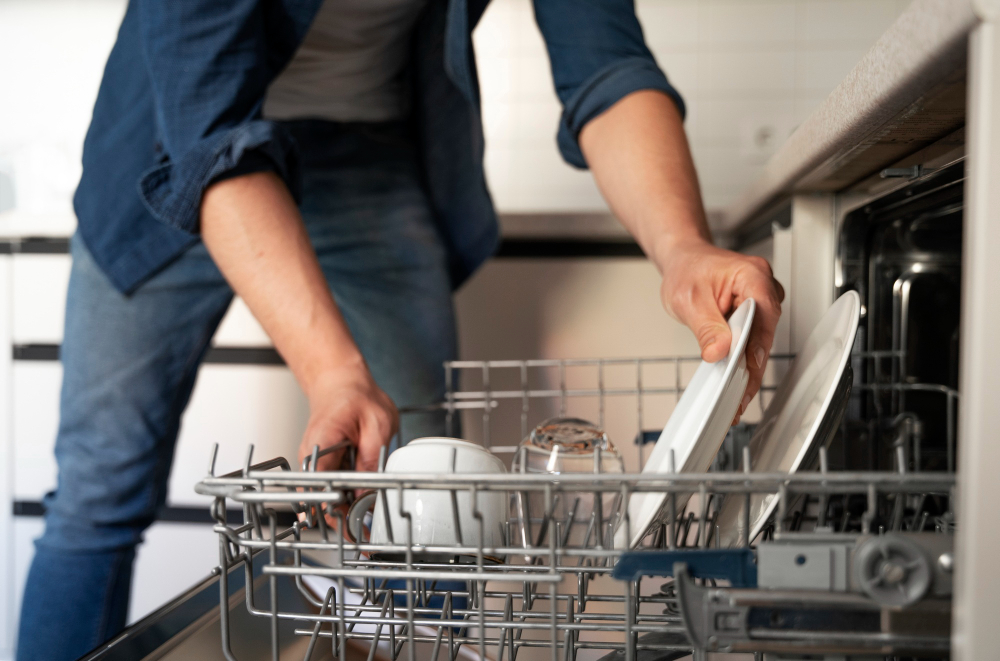
Bowls, lids, and curved items that face up instead of at an angle naturally collect water during the wash cycle and hold onto it through drying, regardless of how well the rest of the dishwasher is working. This is the simplest cause to fix and worth ruling out before assuming a part has failed.
What to try: Angle bowls, cups, and curved lids downward or at a steep tilt rather than facing straight up. Overloading the rack so items touch each other also blocks airflow and traps moisture between pieces — leave space between items where possible.
What happened on a recent Whirlpool dishwasher repair in Elmwood Park
A homeowner in Elmwood Park, IL called us about their Whirlpool dishwasher leaving dishes completely wet at the end of every cycle, even though everything came out clean. They had already refilled the rinse aid with no improvement. Our technician found that the heating element had failed entirely — it was no longer producing any heat during either the wash or dry portion of the cycle, which also explained why dishes were taking longer to feel clean despite looking fine. He replaced the heating element and confirmed proper drying on a full test cycle before leaving, with no other parts affected.
Refrigerator and dishwasher drying issues — is this an energy-saving setting?
Many newer dishwashers, including several Energy Star-certified models, use passive air-drying instead of a heated dry cycle by default to save electricity. If your dishwasher is relatively new and drying has never worked particularly well since day one — rather than gradually getting worse — check your settings menu for a "Heated Dry," "Sani Rinse," or "Boost" option and make sure it's switched on. This is not a fault at all, just a setting most people don't realize exists.
Dishwasher repair in Elmwood Park and Chicago
We diagnose and repair dishwasher heating element, rinse aid, and vent issues throughout Elmwood Park, Chicago, Evanston, Oak Park, and Niles. Most heating element and vent motor repairs are completed in under an hour with parts already on the truck.
Call us or book online. We diagnose the issue, give you a clear estimate before any work begins, and back every repair with our 30-day labor warranty.
Related: Dishwasher Repair Chicago · Why your dishwasher leaves dishes dirty · Dishwasher won't drain completely · Whirlpool Appliance Repair Chicago · Bosch Appliance Repair Evanston