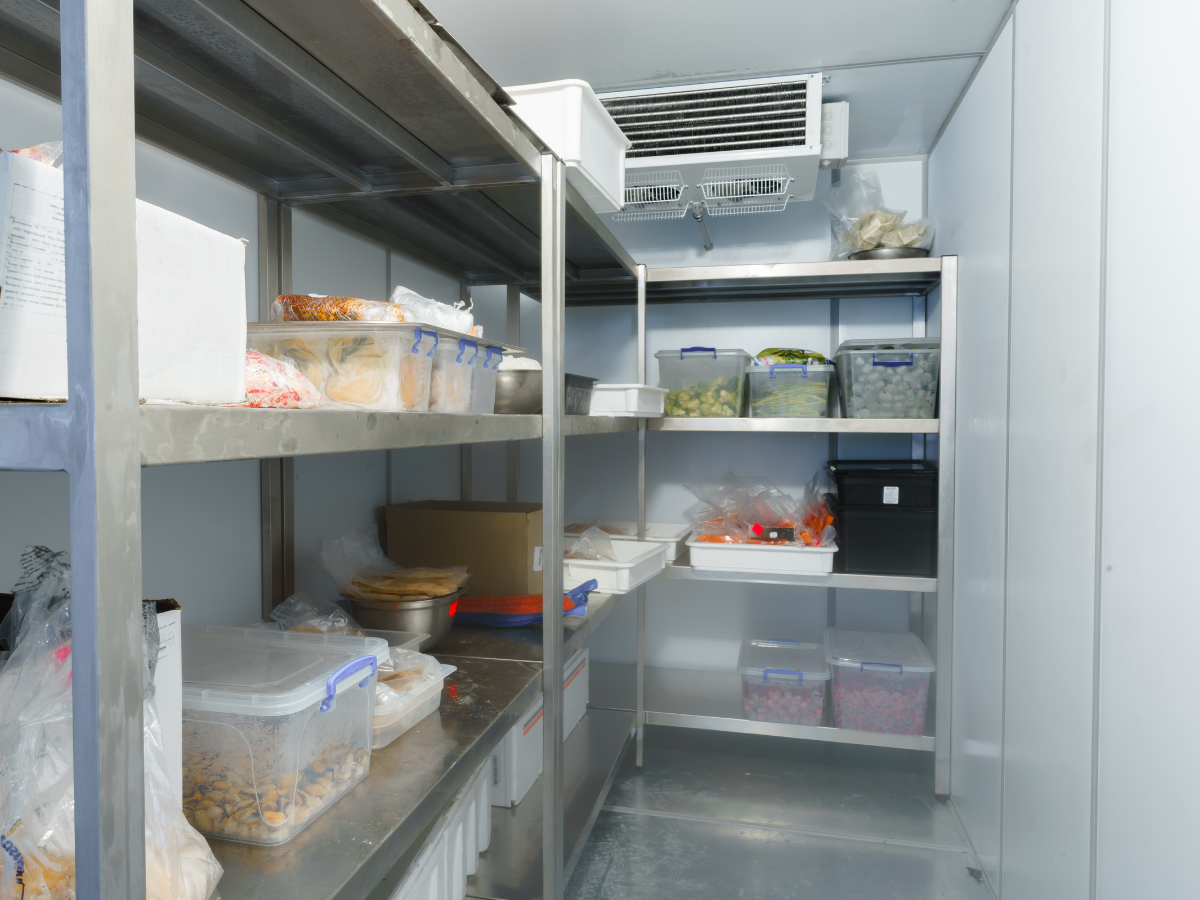
What temperature should a walk-in cooler maintain?
The USDA and most state health codes in Illinois require:
- Walk-in cooler: 35°F to 38°F (1.7°C to 3.3°C) — never above 41°F
- Walk-in freezer: 0°F (-18°C) or below at all times
If your walk-in cooler is reading above 41°F, you are in a dangerous temperature range for food safety. Illinois Department of Public Health regulations require that all potentially hazardous food be held at 41°F or below. A cooler running above this threshold during a health inspection is an automatic critical violation. Please move the temperature-sensitive inventory to a backup unit as soon as possible and contact for service.
Why would a walk-in freezer stop working?
Walk-in freezers share the same core refrigeration components as walk-in coolers—compressor, condenser, evaporator, and expansion valve, but operate at much lower temperatures, which puts greater stress on every component. The most common reasons a walk-in freezer stops working:
Compressor failure
The compressor is the heart of the refrigeration system. On a walk-in freezer, the compressor runs more cycles per hour than on a cooler because it is maintaining a much lower temperature differential. When the compressor fails — due to age, refrigerant contamination, or electrical fault — the unit stops producing cold entirely. The evaporator fans may still run, circulating room-temperature air, which is why some operators do not immediately realize the compressor has failed.
Signs: Unit running but not getting cold, the compressor is making a clicking or rattling sound before shutting off, the compressor is completely silent when it should be running, circuit breaker tripping repeatedly.
Refrigerant leak
A refrigerant leak causes gradual loss of cooling capacity. The unit runs longer and longer to maintain temperature, then eventually cannot maintain it at all. On walk-in freezers, a slow leak often goes unnoticed for weeks because the unit compensates by running more frequently — until energy bills rise noticeably and temperature starts climbing.
Signs: Unit running constantly, but the temperature is slowly rising over days or weeks; there are ice patterns on the refrigerant lines that look unusual or uneven; there is a hissing sound from the refrigerant lines or coils, frost forming in unexpected places.
Defrost system ailure
Walk-in freezers accumulate frost on the evaporator coils faster than coolers. The defrost system — defrost heaters, defrost timer or control board, and defrost thermostat — melts this frost at scheduled intervals. When the defrost system fails, frost builds up until ice completely blocks the evaporator coils and stops airflow. The freezer may still show a low temperature on the thermostat while the actual food temperature rises because cold air can no longer circulate.
Signs: Heavy ice buildup visible on the evaporator coils or ceiling of the walk-in, reduced airflow from the evaporator fans, temperature slowly rising despite the unit running normally.
Evaporator fan motor failure
The evaporator fans circulate cold air throughout the walk-in. On larger walk-in units there are multiple fan motors — if one fails, cold spots and warm spots develop. If all fans fail, the unit stops circulating air entirely even though the refrigeration system is still producing cold.
Signs: Uneven temperature throughout the walk-in, one area significantly warmer than another, fans not running or running slower than normal, unusual noise from the evaporator fan housing.
What are the most common problems with walk-in coolers?
Walk-in coolers share many failure modes with freezers, but also have their own common issues driven by heavier door traffic and the specific temperature range they maintain:
Walk-in cooler not keeping temp or not getting cold enough
If your walk-in cooler is running but cannot get below 45°F or 50°F, the most common causes in order of likelihood are:
- Dirty or blocked condenser coils — the most frequently overlooked maintenance item. Condensers on walk-in units accumulate grease, dust, and debris from kitchen environments significantly faster than residential units. A condenser that has not been cleaned in 6 months in a commercial kitchen can reduce cooling capacity by 20–30%.
- Door gasket worn or damaged — walk-in doors take heavy daily traffic. A worn gasket allows warm kitchen air to infiltrate continuously, overloading the refrigeration system.
- Refrigerant low or leaking — gradual loss of cooling capacity over weeks.
- Thermostat or temperature controller fault — the unit may be running correctly but the controller is calling for the wrong temperature or reading incorrectly.
Walk-in door not sealing properly
The walk-in door is the single most stressed component on the entire unit. Heavy traffic, impacts from carts and deliveries, and constant temperature cycling cause hinges to sag, gaskets to wear, and door panels to warp over time. A door that does not seal completely forces the refrigeration system to work far harder than designed.
Test: With the walk-in running, hold your hand near the door frame while the door is closed. If you can feel cold air escaping, or warm air is visibly condensing at the frame, the door seal has failed.
Condenser unit overheating
In commercial kitchens, the condenser unit is often located in a mechanical room, on the roof, or adjacent to cooking equipment. If the condenser does not have adequate airflow or is positioned near heat sources, it overheats and the compressor trips on thermal overload — causing the unit to cycle off before reaching the set temperature.
Signs: Unit cooling for a period, then warm air from the evaporator, then cooling again in a cycle. Compressor hot to the touch. High-pressure fault code on electronic controllers.
How urgent is a walk-in cooler or freezer repair?
More urgent than almost any other commercial appliance failure. Here is how to triage:
- Walk-in cooler above 41°F — food safety emergency. Move perishables immediately. Call for same-day service.
- Walk-in freezer above 10°F — frozen inventory at risk within hours. Call for same-day service.
- Temperature rising but still within safe range — schedule service within 24 hours. Do not wait — walk-in problems do not resolve themselves and get more expensive the longer they run degraded.
- Unusual noise but temperature holding — schedule within 48–72 hours. The noise is warning you of an impending failure.
Same-day walk-in cooler repair in Chicago
A Chicago restaurant called us after their walk-in cooler temperature climbed from 38°F to 52°F overnight. The compressor was running and the evaporator fans were circulating air, but the unit could not pull temperature down.
When our technician arrived, he found the condenser coils on the rooftop condensing unit completely caked with grease and kitchen exhaust residue — the exhaust vent from the commercial kitchen hood ran directly adjacent to the condenser intake. The condenser had not been serviced in over a year. After a full condenser cleaning and a refrigerant level check (refrigerant was slightly low, consistent with a minor leak), the unit pulled down to 37°F within 90 minutes.
Location: Chicago, IL
Unit: Commercial Walk-In Cooler
Issue: Temperature rising to 52°F overnight, compressor and fans running
Diagnosis: Condenser coils completely blocked with grease from adjacent kitchen exhaust; refrigerant slightly low
Repair: Full condenser cleaning, refrigerant topped up, temperature verified at 37°F
Technician: Ihor
How often should a walk-in cooler be serviced?
In a commercial kitchen environment, walk-in refrigeration equipment should be professionally serviced every 6 months — not annually as with residential refrigerators. The grease, heat, and heavy usage cycles of a commercial kitchen accelerate wear on every component. A twice-yearly service that includes condenser cleaning, door gasket inspection, refrigerant level check, and evaporator coil inspection prevents most emergency failures before they happen.
Walk-in cooler and freezer repair in Chicago
We service commercial walk-in coolers and freezers throughout Chicago and the surrounding suburbs. Our commercial refrigeration technicians respond to temperature emergencies same day and carry common compressor contactors, defrost timers, evaporator fan motors, and door gasket components on every service vehicle.
Call us immediately if your walk-in is above a safe temperature. We diagnose the issue, give you a clear estimate before any work begins, and back every repair with our 30-day labor warranty.
Related: Walk-In Cooler Repair Chicago · Commercial Refrigerator Repair Chicago · Commercial Freezer Repair Chicago · Freezer not freezing — causes and repair