What are the most common commercial oven issues in Chicago restaurants?
Commercial ovens — including convection ovens, deck ovens, combination ovens, and commercial ranges — fail in predictable ways. Here are the issues our technicians see most often:
1. Commercial oven not heating or not reaching temperature
The most common commercial oven call we receive. The oven is turned on, and the thermostat is set, but it never reaches the desired temperature or takes much longer than usual to preheat. In a commercial kitchen setting, the most common causes are
Gas igniter failure:
In gas commercial ovens, the igniter glows orange to light the burner. If the igniter loses power, it will take much longer to ignite the gas, or may not ignite it at all. A properly working commercial gas igniter glows bright orange and ignites the burner within 30 to 90 seconds. If the igniter has a dull orange glow for several minutes and the burner still won’t light, replace the igniter.
Thermostat or temperature sensor failure:
The oven thermostat turns the burner or heating element on and off to maintain the set temperature. If the thermostat goes bad , or the temperature sensor gets out of calibration, the oven will either underheat severely or shut off prematurely. Food takes much longer than you expect to cook and baking results are inconsistent.
Bake or broil element failure (electric ovens):
On electric commercial ovens, both the bake and broil elements can burn out independently. A visible break, blister, or burn mark on the element indicates failure. On convection ovens, the convection element or convection fan motor can fail independently of the bake element.
Gas valve failure:
The gas valve regulates the flow of gas to the burner. If it partially fails, the burner will light but not generate enough heat . If it fails completely, you will not get any flame on the burner even if your igniter is working.
2. Commercial oven temperature not accurate
The oven reaches the temperature specified by the thermostat dial or digital display, but an independent thermometer placed inside the oven reads significantly differently—often 25°F to 75°F off from the set temperature. This leads to inconsistent cooking results, undercooked proteins, and overbrowned baked goods.
Causes: Causes: On older commercial ovens, the most common cause is thermostat calibration drift. The thermostat sensing bulb, a small probe inside the oven cavity, loses accuracy with time and heat cycles. On digital commercial ovens, a failed temperature probe causes the same issue.
What to check: Place a calibrated commercial oven thermometer in the center of the oven cavity and compare against the set temperature after a full 20-minute preheat. A discrepancy of more than 25°F requires either thermostat recalibration or temperature probe replacement.
3. Commercial oven not maintaining temperature during service
During preheat, the oven reaches the correct temperature, but it loses temperature during service when the door is repeatedly opened and closed. Recovery time - the time it takes for the oven to reheat after the door is opened - is longer than normal.
Causes: Door gasket worn or damaged, allowing heat to escape continuously. On convection ovens, a failing convection fan motor circulates air less effectively, reducing heat distribution and recovery speed. On gas ovens, a partially blocked burner orifice or weakening gas valve produces insufficient BTUs to recover temperature quickly.
What to check: Inspect the door gasket around the full perimeter of the oven door. Cracks, gaps, or sections that no longer make full contact with the door frame allow significant heat loss during service.
4. Commercial range burners that do not ignite
Commercial range individual burners do not light, light intermittently, or take several attempts to catch. If you have a commercial range with standing pilots and the pilot keeps going out, the thermocouple is bad. If it clicks but does not light, the burner orifice is usually clogged, the igniter tip is wet or the spark module has failed on commercial ranges with electronic ignition.
What to check: Remove and inspect the burner cap and orifice. In a commercial kitchen, grease and food debris accumulate in the burner ports faster than in a residential kitchen. Clean the ports with a small wire brush. If the burner still will not light after cleaning, the igniter or spark module needs to be replaced.
5. Commercial oven door not closing or sealing
Oven door hinges wear under the constant opening and closing of commercial service. A door that does not close fully or does not seal against the frame causes significant heat loss, longer cook times, and higher energy consumption. On self-cleaning commercial ovens, a door that does not latch correctly prevents the self-clean cycle from initiating.
What temperature should a commercial oven maintain?
Temperature requirements vary by oven type and use, but standard commercial kitchen guidelines are:
- Convection oven: 300°F to 500°F operating range, typically set 25°F lower than conventional oven temperatures due to fan-assisted heat distribution
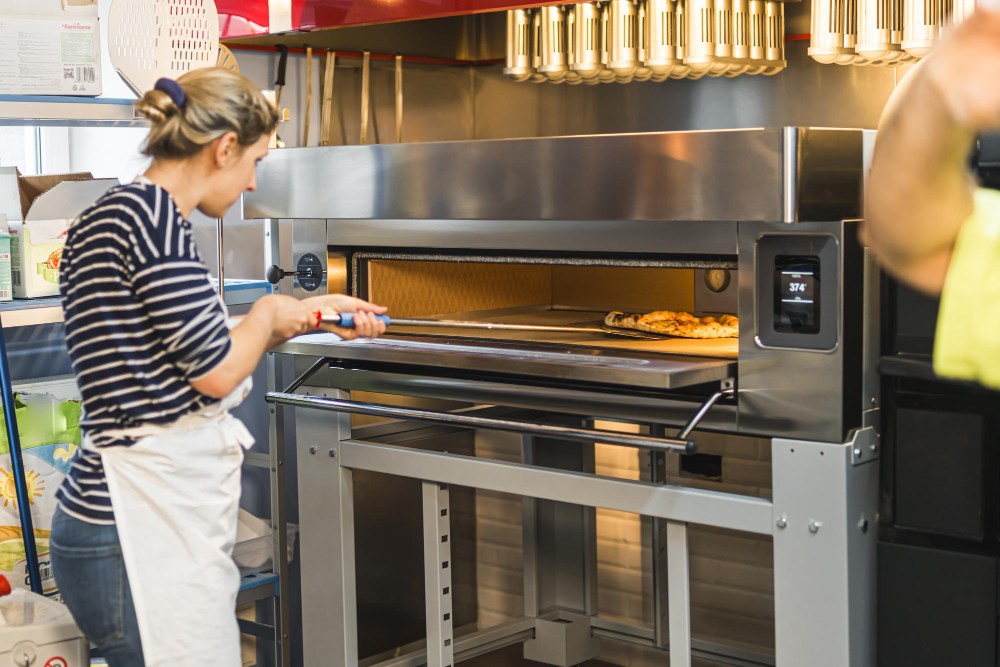
- Deck oven (pizza/bread): 450°F to 600°F for pizza, 375°F to 425°F for bread
- Commercial range oven: 300°F to 550°F depending on menu
- Combination oven (combi): 85°F to 570°F across steam, convection, and combination modes
Illinois Department of Public Health food safety guidelines require that all cooked proteins reach internal temperatures that cannot be achieved reliably if the oven is more than 25°F off its set temperature. An inaccurate commercial oven is not just an equipment problem — it is a food safety and health code compliance issue.
Same-day restaurant oven repair in Chicago
Location: Evanston, IL
Unit: Garland Commercial Deck Oven
Issue: Uneven temperature across deck — 470°F left, 530°F right at 525°F setting
Diagnosis: Left burner partially blocked with carbon deposits, thermostat drift
Repair: Burner cleaned, thermostat recalibrated, even temperature verified across full deck
Technician: Slava
A pizzeria in Evanston called us after their Garland deck oven began producing inconsistent results — pizzas on the left side of the deck were undercooked, while those on the right side were browning correctly. The oven was set to 525°F but an independent thermometer showed 470°F on the left deck and 530°F on the right.
Our technician found the left deck burner partially blocked with carbon deposits, reducing heat output on that side. He cleaned the burner ports and orifice, recalibrated the deck thermostat, and confirmed even temperature distribution across the full deck surface before completing the repair.
How urgent is a commercial oven repair?
More urgent than almost any other commercial kitchen equipment failure. A restaurant that cannot use its oven cannot serve its full menu. Here is how to triage:
- Oven completely cold, service in under 2 hours — same-day emergency call immediately
- Oven running but temperature significantly off — food safety risk, call same day
- Oven working but slow recovery time — schedule within 24–48 hours before it worsens
- One burner not igniting on a multi-burner range — schedule within 48–72 hours
Commercial oven and range repair in Chicago
We service commercial ovens and ranges throughout Chicago and surrounding suburbs — restaurants, pizzerias, cafes, hotels, and institutional kitchens. We work on all major commercial cooking equipment brands, including Vulcan, Wolf, Garland, Southbend, Imperial, Montague, and Blodgett.
Call us immediately if your commercial oven has stopped heating or is producing inconsistent temperatures during service. Same-day service is available for commercial oven emergencies across Chicago. We diagnose the issue, give you a clear estimate before any work begins, and back every repair with our 30-day labor warranty.
Related: Commercial Range Repair Chicago · Oven and Range Repair Chicago