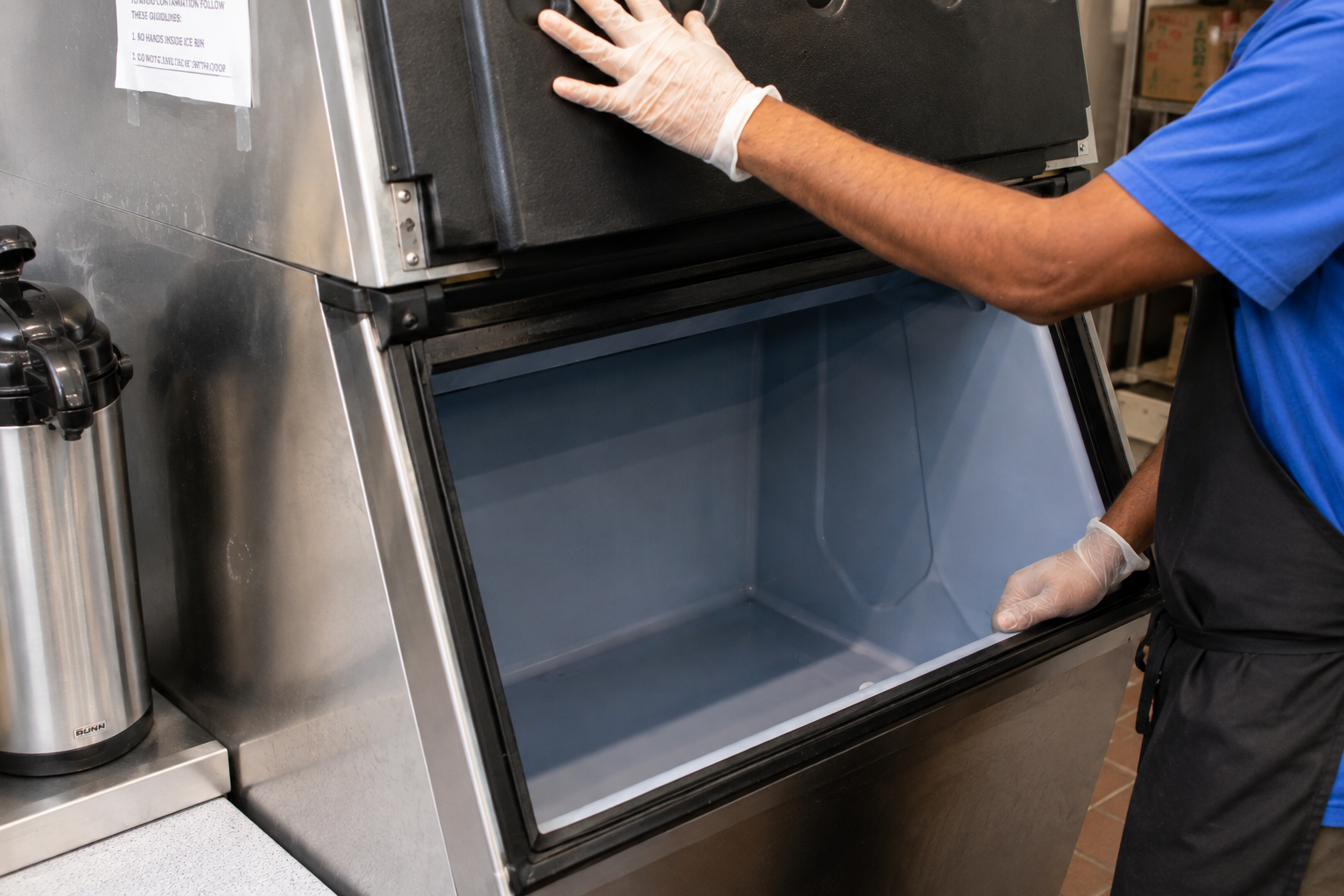
Why is my commercial ice machine not making ice?
Commercial ice machines, including Manitowoc, Hoshizaki, Ice-O-Matic, Scotsman, and Follett units, stop producing ice for a predictable set of reasons. Here are the most common causes our technicians diagnose on Chicago restaurant and bar service calls:
1. Dirty or blocked condenser
It is the leading cause of low or no ice production in commercial settings. When the condenser is coated with grease, dust, and kitchen exhaust residue, the machine is unable to shed heat efficiently, and the freeze cycle slows or stops completely.
In a commercial kitchen, condensers can become critically dirty in as little as 60 to 90 days. Air-cooled machines with condensers located near cooking equipment are especially vulnerable. A machine that was producing 300 pounds of ice per day may drop to 100 pounds with a moderately dirty condenser — and stop entirely once the condenser is completely blocked.
What to check: Locate the condenser (usually at the front or back of the unit behind a grille) and shine a light through the fins. If you cannot see light through them, the condenser needs professional cleaning immediately. This is not a job for compressed air in a kitchen environment — grease embeds into the fins and requires degreaser and a soft brush to remove correctly.
2. Low water supply or water filter blocked
Commercial ice machines require a steady water pressure of 20 to 80 PSI and a flow rate of 1 GPM or more to fill the ice mold properly. If the water supply valve is partially closed, the inline water filter is clogged or the water pressure is low, the machine will make undersized or hollow ice cubes before it stops making ice.
What to check: Make sure the water supply valve is fully open. Check how long it has been since the inline water filter was last changed. In Chicago area, where water hardness is moderate to high, commercial ice machine filters should be changed out every 6 months. A clogged filter decreases the production and accelerates the formation of scales inside the machine.
3. Scale buildup on the evaporator plate
Chicago water supply deposits mineral scale on the evaporator plate, the actual surface where the ice is formed. Scale increases, heat transfer efficiency drops and it takes longer to form ice. The machine produces fewer ice cubes per cycle, the cubes are smaller or have visible cloudy cores, and eventually the harvest cycle fails altogether because the cubes will not come free cleanly from the plate.
What to check: Look inside the ice-making compartment at the evaporator plate. White, chalky deposits on the plate surface are mineral scale. Commercial ice machines should be descaled with an approved ice machine cleaner every 6 months — more frequently in high-production environments.
4. Refrigerant leak or compressor fault
If the condenser is clean, the water supply is OK and the evaporator is free from scale but the machine still produces no ice or very little ice then a refrigerant leak or compressor fault is the likely explanation. The freeze cycle begins, but ice does not form completely or does not form at all due to the refrigerant not reaching the correct temperature.
Signs: Freeze cycle takes much longer than normal before harvest, ice cubes are thin or incomplete, machine cycles frequently without producing usable ice, and compressor is running but evaporator plate is not cold to the touch. freeze cycle runs significantly longer than normal before harvest, ice cubes are thin or incomplete, the machine cycles frequently without producing usable ice, and the compressor is running but the evaporator plate is not getting cold to the touch.
What to do: Stop running the machine and call for service. Running a commercial ice machine with low refrigerant accelerates compressor wear and turns a refrigerant top-up into a full compressor replacement. This is a same-day emergency call.
5. Harvest cycle failure
Commercial ice machines form ice on the evaporator plate and then release the ice into the storage bin via a harvest cycle, a short warm period that makes the ice slide off the plate. If the harvest cycle does not work, either because of a bad valve, bad hot gas solenoid or a bad control board, ice will form on the plate but will not come off. The machine attempts to harvest, the plate gets iced over completely and production stops.
Signs: Ice visible on the evaporator plate that is not falling into the bin, machine cycling repeatedly without ice dropping, error code on the control panel.
How do I reset a commercial ice machine?
Reset procedures vary by brand. Here are the most common:
Manitowoc ice machine reset
Press and hold the OFF button for 3 seconds until the machine powers down. Wait 30 seconds. Press the ON/ICE button to restart. On newer Manitowoc models with a touchpad, navigate to Settings → Diagnostics → Reset. After any reset, allow a full freeze cycle (typically 20–35 minutes) before evaluating whether ice production has resumed.
Hoshizaki ice machine reset
Locate the ON/OFF toggle switch inside the front panel. Flip to OFF, wait 60 seconds, then flip back to ON. Hoshizaki machines require a full minute of power-off time to clear the control board memory. On KM series modular units, the reset switch is on the right side of the control board behind the front panel.
Ice-O-Matic reset
Press the OFF switch and wait 5 minutes — Ice-O-Matic requires a longer reset interval than most brands to clear the thermal protection circuit. Restart by pressing the ICE switch. If the machine trips off again within one cycle, a thermal overload or refrigerant fault is preventing normal operation.
Scotsman ice machine reset
On Scotsman units, press the red reset button located on the control board inside the front panel. Hold for 5 seconds. Scotsman machines with the AutoAlert system will display a code on the panel before shutdown — record this code before resetting, as it identifies the specific fault that caused the shutdown.
Important: A reset clears the error display but does not fix the underlying fault. If the machine shuts down again within one or two cycles after a reset, it needs to be serviced — repeated resets without repair accelerate component wear.
What is the average lifespan of a commercial ice machine?
A properly maintained commercial ice machine lasts 7 to 10 years in a typical Chicago restaurant or bar environment. Here is how maintenance affects that lifespan:
- With regular maintenance (every 6 months): 9–12 years is achievable on quality brands like Manitowoc and Hoshizaki
- With minimal maintenance: 5–6 years before major component failures become uneconomical to repair
- In high-production environments (bars, hotels, high-volume restaurants): Expect the lower end of the range regardless of maintenance
The single largest factor that shortens the life of commercial ice machines in Chicago kitchens is not cleaning the condenser. A machine that runs hot because of a dirty condenser puts constant strain on the compressor, the most expensive part to replace. A simple cleaning of the condensers will add 2 to 3 years to the life of the machine.
When is it better to replace than repair? If the machine is more than 8 years old and the repair cost is greater than 50% of the cost of a new unit of comparable capacity, replacement is usually the better financial decision. Newer machines are far more energy efficient, which reduces operating costs. We’ll give you the straight talk on this – if replacement makes more sense than repair for your particular unit, we’ll let you know up front.
Same-day commercial ice machine repair in Chicago
Location: Chicago, IL
Unit: Manitowoc Commercial Ice Machine
Issue: No ice production, empty bin
Diagnosis: Condenser completely blocked with grease — heat dissipation failure
Repair: Full condenser degreasing and cleaning, production confirmed before technician left
Technician: Maksym
A bar manager in Chicago called us during a Friday afternoon rush after their Manitowoc ice machine stopped producing ice completely. When our technician Maksym arrived, he found the condenser completely blocked with grease and kitchen exhaust residue — the condenser had not been professionally cleaned in over a year. After a full condenser degreasing and cleaning, the machine began producing ice within 45 minutes and was back to full production.
How often should a commercial ice machine be serviced in Chicago?
Every 6 months minimum in a commercial kitchen environment. The service should include:
- Full condenser cleaning — degreasing and brushing fins
- Evaporator plate descaling with approved ice machine cleaner
- Water filter replacement
- Inspection of water distribution tubes and float valve
- Sanitizing the storage bin and all ice-contact surfaces
- Refrigerant level check
- Control board diagnostic scan for stored fault codes
In Chicago, where summer heat and humidity stress condensers harder, some high-production environments benefit from quarterly condenser cleaning rather than semi-annual.
Commercial ice machine repair in Chicago
We service commercial ice machines throughout Chicago and the surrounding suburbs — restaurants, bars, hotels, cafes, and healthcare facilities. We work on all major commercial ice machine brands, including Manitowoc, Hoshizaki, Ice-O-Matic, Scotsman, and Follett.
Call us immediately if your ice machine has stopped producing ice or is producing significantly less than normal. Same-day service is available for emergency ice machine failures across Chicago. We diagnose the issue, give you a clear estimate before any work begins, and back every repair with our 30-day labor warranty.
Related: Commercial Ice Maker Repair Chicago · Ice Maker Repair Chicago · Walk-in cooler problems · Commercial Refrigerator Repair Chicago